

MaximumDepthClassifier#
- class skfda.ml.classification.MaximumDepthClassifier(depth_method=None)[source]#
Maximum depth classifier for functional data.
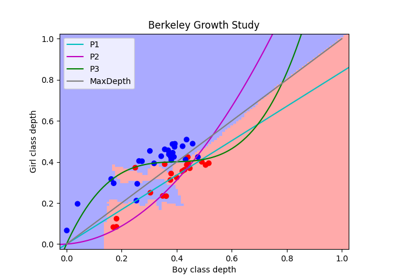
Test samples are classified to the class where they are deeper [1].
- Parameters:
depth_method (Depth[Input] | None) – The depth class to use when calculating the depth of a test sample in a class. See the documentation of the depths module for a list of available depths. By default it is ModifiedBandDepth.
Examples
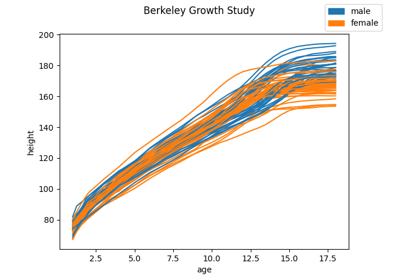
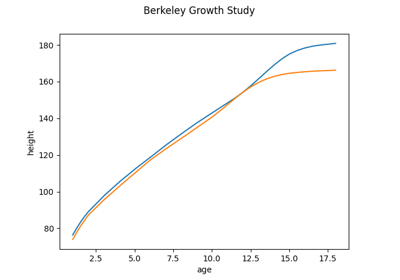
Firstly, we will import and split the Berkeley Growth Study dataset
>>> from skfda.datasets import fetch_growth
>>> from sklearn.model_selection import train_test_split
>>> dataset = fetch_growth()
>>> fd = dataset['data']
>>> y = dataset['target']
>>> X_train, X_test, y_train, y_test = train_test_split(
...     fd, y, test_size=0.25, stratify=y, random_state=0)
We will fit a Maximum depth classifier
>>> from skfda.ml.classification import MaximumDepthClassifier
>>> clf = MaximumDepthClassifier()
>>> clf.fit(X_train, y_train)
MaximumDepthClassifier(...)
We can predict the class of new samples
>>> clf.predict(X_test) # Predict labels for test samples
array([ 1, 1, 1, 1, 1, 1, 1, 0, 0, 0, 0, 1,
        1, 0, 0, 0, 0, 1, 1, 1, 1, 0, 1, 1])
Finally, we calculate the mean accuracy for the test data
>>> clf.score(X_test, y_test)
0.875
See also
References
Methods
fit(X, y)Fit the model using X as training data and y as target values.
Get metadata routing of this object.
get_params([deep])Get parameters for this estimator.
predict(X)Predict the class labels for the provided data.
score(X, y[, sample_weight])Return accuracy on provided data and labels.
set_params(**params)Set the parameters of this estimator.
set_score_request(*[, sample_weight])Configure whether metadata should be requested to be passed to the
scoremethod.- fit(X, y)[source]#
Fit the model using X as training data and y as target values.
- Parameters:
X (Input) – FDataGrid with the training data.
y (Target) – Target values of shape = (n_samples).
- Returns:
self
- Return type:
DDGClassifier[Input, Target]
- get_metadata_routing()#
Get metadata routing of this object.
Please check User Guide on how the routing mechanism works.
- Returns:
routing – A
MetadataRequestencapsulating routing information.- Return type:
MetadataRequest
- predict(X)[source]#
Predict the class labels for the provided data.
- Parameters:
X (Input) – FDataGrid with the test samples.
- Returns:
- Array of shape (n_samples) with class labels
for each data sample.
- Return type:
Target
- score(X, y, sample_weight=None)[source]#
Return accuracy on provided data and labels.
In multi-label classification, this is the subset accuracy which is a harsh metric since you require for each sample that each label set be correctly predicted.
- Parameters:
X (array-like of shape (n_samples, n_features)) – Test samples.
y (array-like of shape (n_samples,) or (n_samples, n_outputs)) – True labels for X.
sample_weight (array-like of shape (n_samples,), default=None) – Sample weights.
- Returns:
score – Mean accuracy of
self.predict(X)w.r.t. y.- Return type:
- set_params(**params)[source]#
Set the parameters of this estimator.
The method works on simple estimators as well as on nested objects (such as
Pipeline). The latter have parameters of the form<component>__<parameter>so that it’s possible to update each component of a nested object.- Parameters:
**params (dict) – Estimator parameters.
- Returns:
self – Estimator instance.
- Return type:
estimator instance
- set_score_request(*, sample_weight='$UNCHANGED$')#
Configure whether metadata should be requested to be passed to the
scoremethod.Note that this method is only relevant when this estimator is used as a sub-estimator within a meta-estimator and metadata routing is enabled with
enable_metadata_routing=True(seesklearn.set_config()). Please check the User Guide on how the routing mechanism works.The options for each parameter are:
True: metadata is requested, and passed toscoreif provided. The request is ignored if metadata is not provided.False: metadata is not requested and the meta-estimator will not pass it toscore.None: metadata is not requested, and the meta-estimator will raise an error if the user provides it.str: metadata should be passed to the meta-estimator with this given alias instead of the original name.
The default (
sklearn.utils.metadata_routing.UNCHANGED) retains the existing request. This allows you to change the request for some parameters and not others.Added in version 1.3.
- Parameters:
sample_weight (str, True, False, or None, default=sklearn.utils.metadata_routing.UNCHANGED) – Metadata routing for
sample_weightparameter inscore.self (MaximumDepthClassifier)
- Returns:
self – The updated object.
- Return type: